
In the small municipality of Alpiarça, like in other places in Portugal, the presence of immigrants is growing. The school reality reflects the changing social fabric and nowadays classes include students from different communities. Learn how the resources from our project paved the way for a transformative journey of curiosity, awareness, compassion and acceptance led by students.
The work began within the framework of SELF classes—a subject addressing citizenship education across all disciplines, established by the José Relvas School Group.
Eighth-grade students (aged 13–14) started by analyzing the educational materials promoted by the GET project.
The resources provided different perspectives on migration, including testimonies, real stories, and informative data, with a specific focus on how to address media misinformation and react to it.
Starting from there, moments of reflection, discussion, and debate were held in the classroom, where students could express opinions, question preconceived ideas, and delve deeper into concepts such as integration, inclusion, and human rights.Throughout this work, they reflected on how migrants were seen in the past, how they are represented in the present, and how they may be portrayed in the future.
Through the critical analysis of images, the identification and deconstruction of stereotypes, and reflection on the weight of the words used in disseminating news, the students sought to understand how media representations influence the way we see migrants and migratory phenomena.
The book Migrants by Issa Watanabe and the movie Terraferma by Emanuele Crialese were brought into the classroom by the Spanish language and Geography teachers to foster further reflection and inspire creativity among the students. They explored the challenges faced by migrants, the human dilemmas associated with reception and integration, as well as the individual and collective responsibility towards those seeking a better life.
When the students held a video conference with a representative of the Portuguese House in Champigny-sur-Marne, a city in France with which Alpiarça is twinned, considered the capital of the Portuguese migrant community, perspectives shifted. Learning about how the Portuguese first lived there in slums back in the 1950s and 1960s and the difficulties they faced on their path towards integration made them realise what the present challenges faced by the migrants in Portugal actually mean.
“I asked them how many Indian students they spoke to. They realized it wasn’t many – and they began reaching out more,” shared the French teacher.
Given all those inputs, the students rolled up their sleeves. One of the results of their learning path and creative expression was the book Between Gazes and Borders. The stories created by them gave voice to characters who face challenges, cross borders, and seek new life opportunities. Their narratives reflect feelings of hope, courage, belonging, and solidarity, revealing a profound capacity for empathy in the face of migratory experiences.
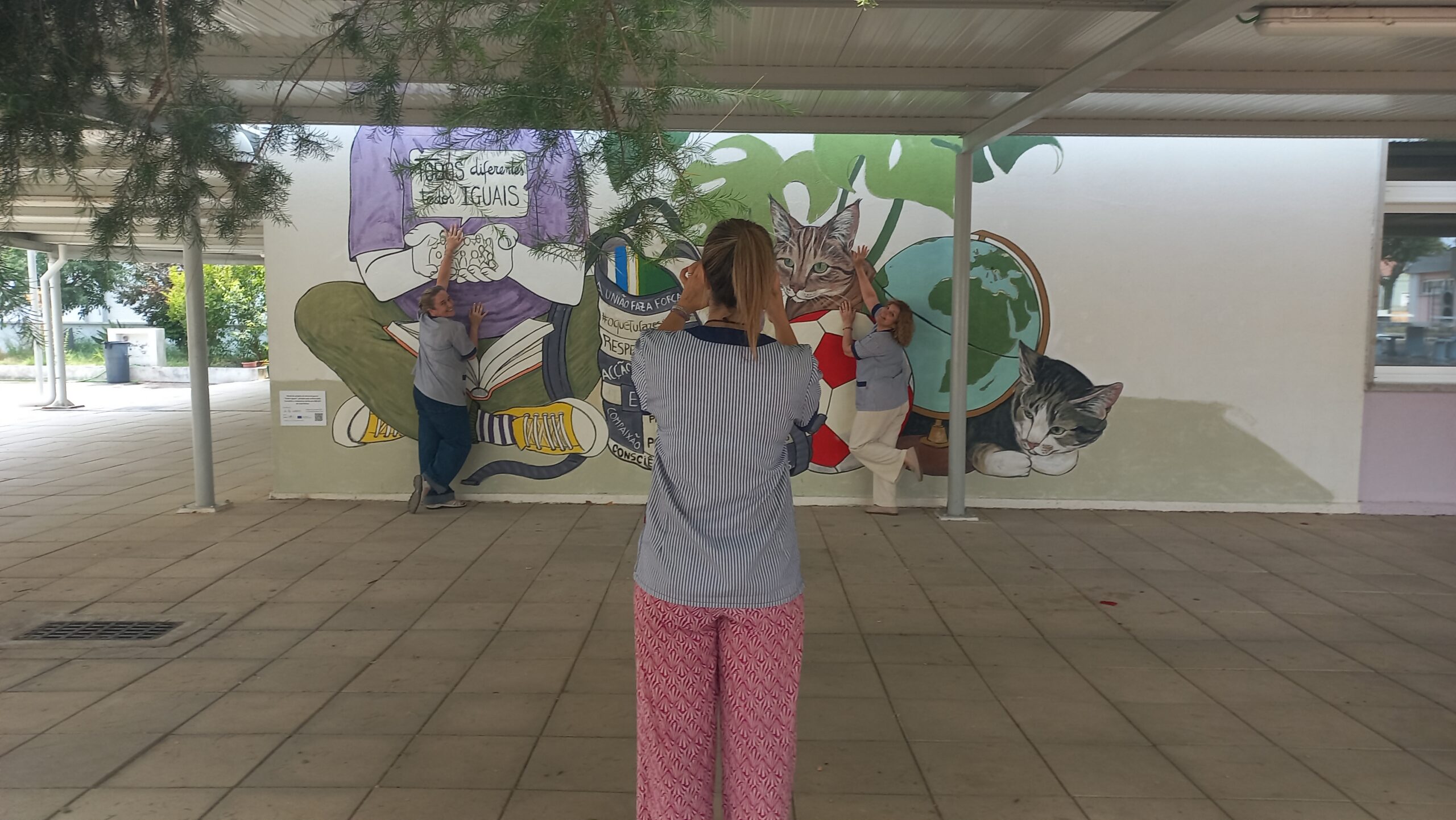
The most visible result of this impressive journey was a mural collectively created and brought to life with the help of Sofia Camacho, a local artist. The mural was painted collaboratively over two days and represented one of our project Youth Actions.
Over those 48 hours, the wall served as a meeting point, a place to share ideas, suggest other activities, and as a bridge to issues that concern these young people, namely climate change, global inequalities, migration, and gender equality.
“All Different, All Equal,” is painted in large, bold letters next to a backpack overflowing with powerful words: Acceptance, Respect, Equality, Protect the Planet, Compassion, Awareness, Helping Others, Do Not Judge, More Love, and Peace.
“It is important that this message goes beyond the school: that we are all different, but all equal,” said one student during the inauguration.
The mural remains visible to the entire school community. People take pictures in front of it. It stands as a monument to tolerance and humanity. A statement of the world these young people want to live in and their willingness to make it real – within their schools and beyond.
Inspired by this story from GET Portugal? Spark the same change by downloading our free educational resources on migration to foster dialogue in your own school or community. Stay connected with us to discover more inspiring Youth Actions and powerful stories of change from across Europe.
